
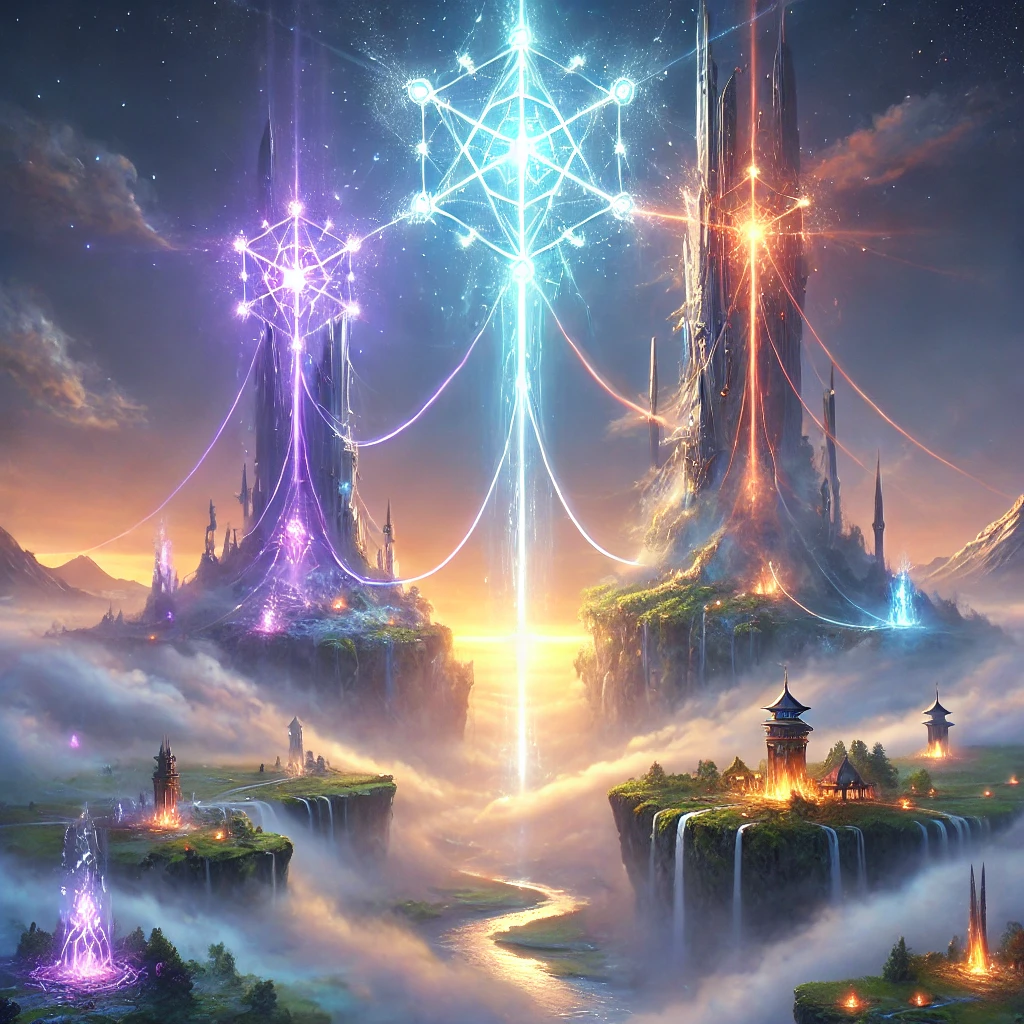
Once upon a time, in a kingdom ruled by the wise King Code, there were two agile teams—Team Spark and Team Synergy. Each team was made up of five members: three developers, one tester, and one product owner. Both teams had the same roles, the same number of members, and the same set of skills, each talented in their craft.
Team Spark resided in the Tower of Cloud Mountain, high upon the peaks where the air was thin and the view stretched far across the kingdom. Team Synergy lived in the Tower of Strategy Plains, located on the fertile lands that stretched wide under the open sky. Though they were equally skilled, with the same balance of roles and talents, a great fog separated their towers, making it impossible for them to communicate directly.
In the Tower of Cloud Mountain, the developers worked hard, creating the digital landscapes of the kingdom, while the tester ensured every feature was polished and free from flaws. The product owner, always keeping the grand vision in mind, guided the team’s work to align with the kingdom’s needs.
In the Tower of Strategy Plains, Team Synergy followed the same rhythm. Their developers crafted intricate solutions, their tester ensured quality, and their product owner worked closely with the king’s advisors to define the most important tasks for the kingdom’s progress.
Despite their equal skills, both teams struggled in isolation. In Team Spark’s tower, the developers sometimes found themselves caught in endless cycles of work that didn’t align with the larger vision. The tester would uncover issues, but the solutions often didn’t quite fit the bigger picture, leading to frustrations. In Team Synergy’s tower, the developers had similar challenges, their work sometimes clashing with the broader goals set by the product owner. Both teams were trying their best, but the lack of direct communication led to inefficiency and misalignment.
Rumors spread that the fog between the towers was growing thicker, threatening the future of the kingdom. The King, desperate to restore balance, called upon his trusted advisor, the Agile Oracle, to find a way to unite the teams.
“The fog is made not of mist, but of confusion and misunderstanding,” said the Agile Oracle. “These teams, though equal in skill, have yet to learn how to align their efforts. Their strength lies in collaboration, and they must learn to see each other’s work as an extension of their own.”
To resolve the issue, the Oracle advised the King to call upon both teams to come together—not by leaving their towers, but by opening channels of communication. “The teams must come to understand one another, to trust one another’s insights,” she said. “Only then will the fog lift.”
The Oracle then presented her brilliant solution: the Crystal Conduit.
The Crystal Conduit was a network of enchanted crystals, each placed within the towers of both teams. These crystals were designed to carry messages through the mist, allowing the teams to communicate clearly, even from afar.
At the heart of each tower, the Crystal Conduit connected the members of the teams in a way that was both visible and interactive. When Team Spark needed to communicate with Team Synergy, they would place their thoughts into the crystal, where they would form as glowing symbols. The symbols would then shimmer through the mist, traveling at the speed of light, until they reached the corresponding crystal in the other tower.
When the message arrived at the Crystal of Strategy Plains, the symbols would transform into a clear, glowing thread that unraveled into readable words, visible to the members of Team Synergy. It was as if the fog itself had no power over the light contained within the crystals. When Team Synergy needed to reply, they would send their messages through the same conduit, and the glowing thread would shimmer back across the mist, traveling in the opposite direction.
These crystals were powered by the Agile Pulse, a rhythmic force generated by the hearts and minds of the team members. Whenever the teams worked together in harmony, their collective efforts would power the Crystal Conduit. The more they collaborated and shared insights, the stronger and clearer the pulses became, ensuring their communication grew more efficient with each passing day.
The Crystal Conduit allowed for instantaneous sharing of updates, feedback, and ideas, regardless of the physical distance. It had been designed not just to deliver messages, but to create a sense of immediacy. As each team interacted, they could see the responses and progress of the other team, as the glowing symbols often left traces of the work they had shared. This helped to align the teams and ensure their progress was synchronized.
In addition to the crystals, there was a central chamber in each tower—the Room of Reflection—where the teams could meet. Within this room, the crystals would glow brightest, and the teams could discuss larger ideas, ask questions, or troubleshoot together, almost as if they were standing side by side, despite being miles apart.
The key to the Crystal Conduit was that it was not merely a tool for communication—it became a conduit for trust. The more the teams used it, the more they understood that the success of one team depended on the success of the other. The flow of information created a rhythm of collaboration that was felt in both towers.
The mist between the two towers, once dense and oppressive, slowly began to thin, as the Crystal Conduit allowed the teams to reach out to one another and align their work more effectively. Over time, the fog lifted entirely, as the teams learned to work in a seamless and continuous flow, with every piece of the digital world they created fitting perfectly together.
And so, the kingdom flourished as the two teams, with the help of their Crystal Conduit, brought their strengths together in a way they never could have done alone. The King, seeing the success of the new communication system, declared that the Crystal Conduit would be a permanent fixture of the kingdom, a reminder of the power of collaboration and shared effort.