
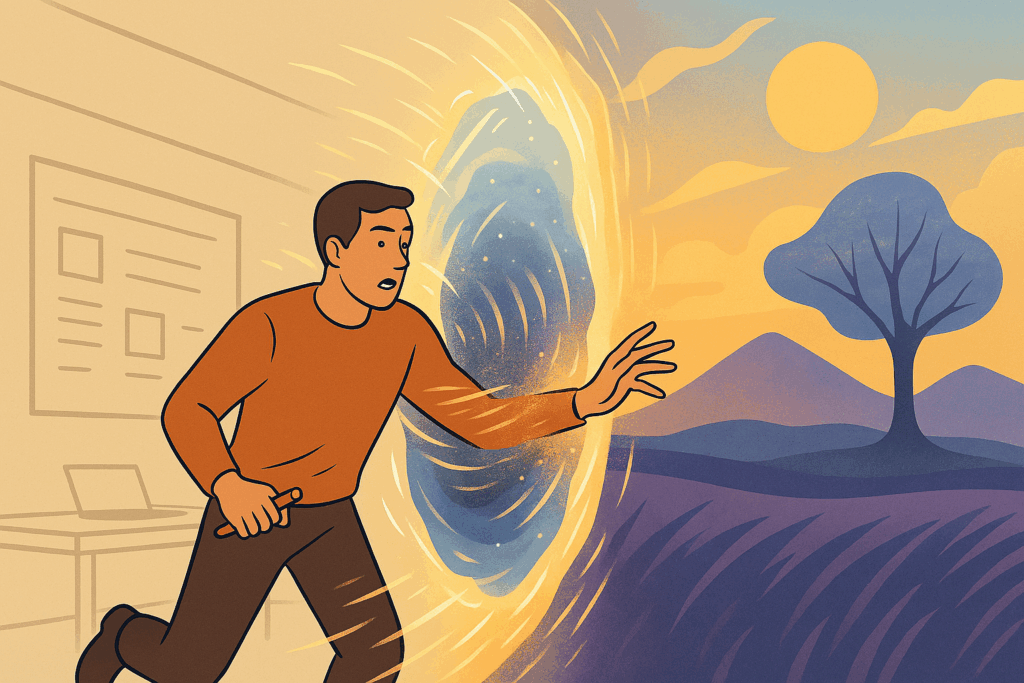
Liam hated Fridays. Not because the week was ending, but because the sprint retrospectives always devolved into polite murmurs and awkward silences. He stood in front of the meeting room, the digital whiteboard glowing behind him, trying to summon energy in a room that looked emotionally jetlagged. “Let us be candid,” he said, “What went well this sprint?” “Um… we had coffee on time every day?” someone offered, half-smiling.
That night, frustrated and feeling disconnected, Liam stayed behind alone in the empty office. He stared at a poster of the Agile Manifesto pinned to the wall. He read it again: “Responding to change over following a plan” and something inside him twitched. “We follow all the plans,” he whispered, “and nothing ever changes.” Determined to make sense of it, he picked up a whiteboard marker and began furiously sketching principles, arrows, circles. Anything that might help him see what he was missing.
Then the marker shimmered. Its tip flickered like static. The whiteboard’s surface rippled. The air thinned and a high, humming tone filled the room, as if the atmosphere were holding its breath. The marker slipped through the board. So did Liam’s hand. And then, with a sudden implosion of silence, everything folded inward. Liam vanished.
He woke up lying on soft moss beneath a sky with two suns. In the distance stood architecture that mirrored NexaCorp’s campus, but the buildings shimmered and pulsed as if they breathed. The world felt familiar yet elevated, some evolved parallel version of his own.
Inside a glass dome labeled “Development Guild,” he found teams casually gathered in circles. No kanban boards. No tickets. No strict ceremonies. People moved with grace and focus, yet no one seemed driven by pressure. He approached a woman deep in conversation. She introduced herself as Kira, a UX designer. “Where are your stand-ups? Do you not run retrospectives?” he asked. She smiled. “We collaborate continuously. We trust. We reflect every day, but we do not need scheduled meetings to prove it. Agile is not about ceremonies. It is about responsiveness, shared purpose, and respect.”Liam’s thoughts raced. Was this what agility could be? Not processes and metrics—but instinct and intent?
He stayed for what felt like weeks, absorbing the rhythm of a world without strict rituals. In place of retrospectives were story circles. In place of roadmaps were dynamic conversations. He built with them. He laughed with them. And eventually, the world whispered him home.
It happened one morning over tea – an herbal blend glowing blue and fragrant with citrus. He bent to take a sip, and as his breath touched the surface, the liquid began to shimmer like a pane of glass catching moonlight. He saw his own reflection, but behind it, the shape of his old office chair. His calendar. His fluorescent ceiling. A strange calm settled over him. He placed the cup gently on the table, gave Kira a quiet nod of gratitude, and leaned in. The surface rippled and drew him in like gravity. For a moment he was suspended between two heartbeats, and then….. He gasped as he stumbled backward in his familiar chair, blinking under pale ceiling lights and the electric hum of office silence. He was back.
Back home, Liam saw everything differently. He did not cancel the next retrospective. But he changed it. He dimmed the lights, brought pastries, and played soft instrumental music. Instead of “What went well?”, he posed new prompts on the wall:
- “What challenged you emotionally this sprint?”
- “When did you feel proud?”
- “Where did we not listen to each other?”
There was a long silence. Then Ana, the quiet backend developer, spoke:
“I almost quit mid-sprint. Not because of the code. Because I felt invisible in that handoff meeting.” The team looked up. Not with judgment, but with care. The whole meeting they talked. They listened. They reflected.
Liam did not need to eliminate ceremonies. He only needed to breathe new life into them. He transformed retrospectives from checkboxes into connection points. Scrum became a scaffold for trust, not a cage.
Six months later, Liam began to wonder if the other world still thrived. One evening, as he tidied up after another deeply honest retro, he picked up the same whiteboard marker; the one that had once sparked his first journey. He rolled it between his palms, more curious than hopeful. And then, something shifted. A warmth ran up his arm. The lights flickered. The whiteboard pulsed as if remembering. Without fear, Liam leaned forward. And once more, crossed through the membrane between realities.
He arrived under twin suns, inhaling the heady scent of violet moss and ozone. But the atmosphere had shifted. The harmony he remembered now felt oddly weightless, as if ideas never landed. Politeness had turned into passivity. Nothing was wrong, yet nothing was truly right.
He found Kira beneath the crystalline tree where they had first spoken. “This place,” she said softly, “feels comfortable, but slow. We talk a lot. But we hesitate to challenge. We lost our edge.” Liam nodded. “In my world, we leaned too much on structure. Here, you leaned too far from it. Let me show you what balance looks like.”
And he did. He facilitated their first retrospective. Not as an outsider, but as a bridge. He introduced timeboxing, focused listening, rotating facilitators. Together, they created new rituals; not rigid, but rooted. He helped them discover that structure, when chosen with care, could act not as walls, but as a door to a new world.
It took time. But something beautiful returned to the air. Discussion that lead to change, not to loosing trust in each other. That gave back the feeling of harmony and growth that had been there before. When the city began to pulse with purpose again, Liam knew it was time.
At the plaza’s edge, beside the shimmering sculpture shaped like a question mark, Kira found him once more. She was carrying a poster, neatly rolled and tied with a silver cord. “We made this,” she said softly. “We thought you might want a reminder of what we found together.” Liam accepted it in silence, his fingers tight on the gift. A quiet exchange. A mutual knowing. Then he turned toward the sculpture’s shadow. He knew it was time. Light bent. Shapes swirled. And with a step, he crossed the threshold once more. The air thickened, the world tugged…. and he was home.
The poster now hangs framed in his team’s workspace. At the centre is a pair of hands. One structured and precise, the other loose and flowing. Reaching across a quiet space between them. Beneath the image, in careful lettering:
“Agile is neither strict process nor total freedom. It is the shared intention to adapt, reflect, and grow together.”
Visitors often pause to read its message. When they ask what it means, Liam always takes a moment. Then he replies: “It means Agile is not a checklist of meetings or tools. And it is not an unstructured space where everyone does whatever they please. I have seen both extremes. One where process smothers creativity, and one where freedom smothers growth. Agile lives in the middle. It thrives when a team chooses, together, to stay open, honest, and willing to change – for each other, and for what they are building.” He pauses, letting the words settle. “It is not about escaping what we were, or chasing what we are not. It is about deliberately shaping who we become. Together!” And then, like always, he turns back to his team. Ready to listen.