
Tom was a dedicated Scrum Master. Not a smooth talker, not a framework-template addict, but just someone with his feet firmly in the trenches. He worked at a mid-sized tech company where Agile had been embraced; or so it seemed on paper. In reality, the rules were followed, but the intent was ignored. Stand-ups were half status meetings, retrospectives a repeat of complaints, and stakeholders mostly saw Scrum as “a more convenient way to micromanage.”
Tom remained calm. He guided his team as best he could. But he felt there had to be something more. A deeper layer. And one morning, while cleaning up old wiki pages, he stumbled upon a clue. On a forgotten internal wiki page, buried behind dead-end links, he found a page with a strange title: “The Order of the White Post-it – For those who no longer do Scrum, but are Scrum.” Curious, Tom began to read. It wasn’t an official manifesto. More of a clandestine ode to the craft of the Scrum Master. The Order, as described, was a secretive network of seasoned professionals who didn’t sell themselves as Agile gurus, but served two purposes with humility: helping their teams grow and subtly steering the organization, without putting on a show.
Their requirements for entry were strict:
- At least 10% of your time must be demonstrably spent on strategic-level management advice.
- You are consistently present at all regular Scrum events.
- You have at least one case in which team autonomy was increased and safeguarded.
- You provide proof of craftsmanship-not in theory, but with tangible impact.
Tom was immediately intrigued. This sounded exactly like what he felt was missing: a balance between service and influence. No method magic, but just real depth. He decided: I want to join. So he started logging his time. He spent well over 90% with the team: coaching, facilitating, supporting, jumping in where needed. He was proud of his closeness. But… that was exactly the problem. He was invisible to management. He gave no strategic advice. And was never asked to.
He tried to get a seat at the table. During a planning session with senior leadership, he cautiously suggested sharing insights from the team. The response was lukewarm: “Nice, but that’s something for the team leads. You just focus on the ceremonies.” When he offered suggestions at a department meeting about better prioritizing customer value, he was thanked….. and then ignored. No one asked for his opinion. And even when he shared something, it was labelled as “operational feedback.” He was trapped in a paradox: the Order demanded strategic thinking. But his role was boxed into operationally “keeping flow in the team.” He was deep in the engine room and no doors to the bridge were opening.
Tom began to change his behaviour, so he might get out of the paradox. He tried stepping back from the team to make space for strategic work, with the hope he would be more convincing. But the team noticed immediately:
“Why where you not available on Monday for questions?”
“Why didn’t you prep the retro as you normally do?”
Team dynamics deteriorated. Issues lingered. Tensions grew. The PO called it “unprofessional” that Tom was no longer fully present. Eventually, he was stuck. He couldn’t hit the 10% strategic work requirement without letting the team down. And he couldn’t advice the company if he had to jump in everywhere.
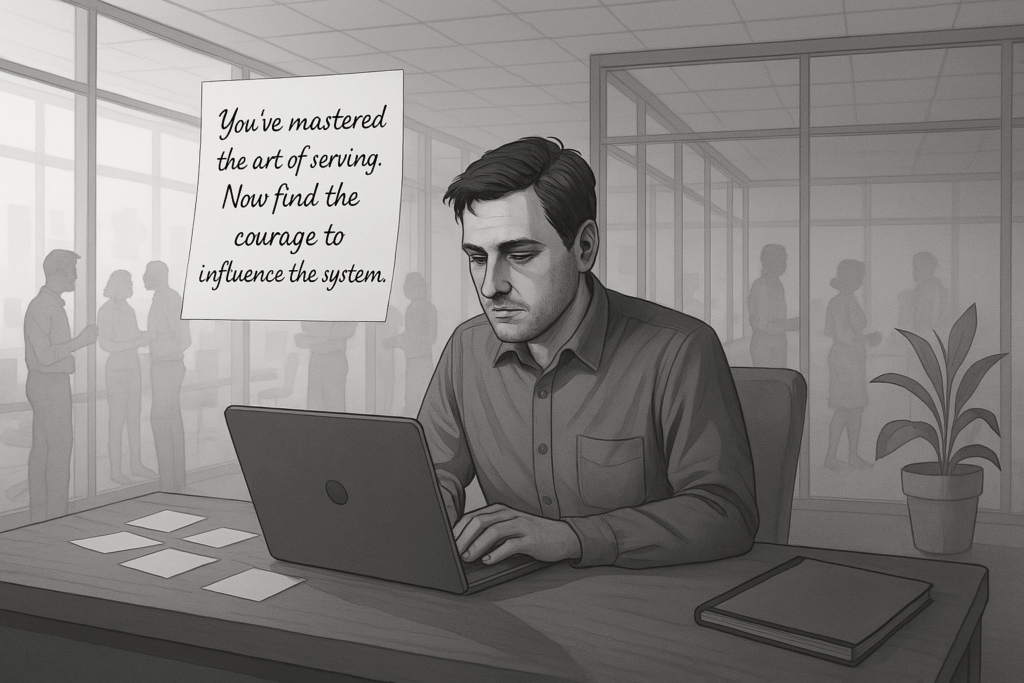
Still, he gave the joining of the order a shot. He documented an attempt at cross-team alignment, an analysis of organizational-level bottlenecks, and a reflection on how he might advise the execs (if they ever asked). He sent it in to the vague mailing address mentioned in a footnote of the manifesto. Three weeks later, he found a white post-it on his keyboard. No invitation. Just one handwritten sentence: “You’ve mastered the art of serving. Now find the courage to influence the system.”
Tom still works there. His team trusts him. The sprint flows. The output is solid. But something gnaws at him. He knows he won’t progress unless he raises his voice beyond the team. But every attempt gets crushed by the walls of “stay focused,” “know your role,” “don’t sit in the leadership’s chair.”
He’s good at his craft.
But not visible enough.
Not strategic enough.
So the Order remains closed.
Not because he falls short,
but because the organization won’t allow him to grow.
The End
(…and maybe it will stay that way)